
How to Search Criminal Dockets
Begin with Search ARCourts, the official entry point for a public Lafayette County criminal docket. It pulls public case information from courts on the Contexte system. Every circuit court supplies at least the statistical information required by Administrative Order 8. Event detail and linked documents vary by court, though. Basic public searching needs no login and carries no advertised fee. Parties, a judge, filings, charges, dispositions, future events, judgments, and some document links may all appear. Some courts show more than others.
Have the full case number ready if you can. Without it, search by participant. Then narrow the live results to Lafayette County and the right court. Check the court, case type, filed date, judge, and status. Only then read the event list. The portal is a discovery tool. For the authoritative copy, ask the clerk for a certified record.
- Decide whether the charge belongs to Lafayette County Circuit Court or the relevant District Court department.
- Open Search ARCourts and use the full court-assigned case number, preserving hyphens and leading zeros.
- If needed, search by first, middle, and last name, then apply Lafayette and court filters offered by the live interface.
- Open the matching case and check each charge, filing, future event, plea, disposition, and judgment in date order.
- Call the responsible clerk for a current setting, an old file, an absent image, or a plain or certified copy.
Lafayette Criminal Docket Court Split
Felony charges go to Lafayette County Circuit Court. It is the general-jurisdiction court in the Eighth South Judicial Circuit. Misdemeanors, ordinary traffic matters, and local-ordinance cases usually start in Lafayette County District Court. That split matters. A search limited to Circuit Court can miss a valid lower-court criminal case. The court printed on a citation or notice is the best routing clue.
| Matter | Docket keeper | Search path |
|---|---|---|
| Felony prosecution | Lafayette County Circuit Clerk | Search ARCourts, then Circuit Clerk |
| Misdemeanor or ordinance case | District Court clerk | Search ARCourts if participating, then issuing court |
| Appeal from District Court | Circuit Clerk after circuit filing | Follow the new circuit case number |
The Arkansas Judiciary Circuit Clerk directory maps the official clerk route for court records. Its Lafayette County criminal docket listing appears below.
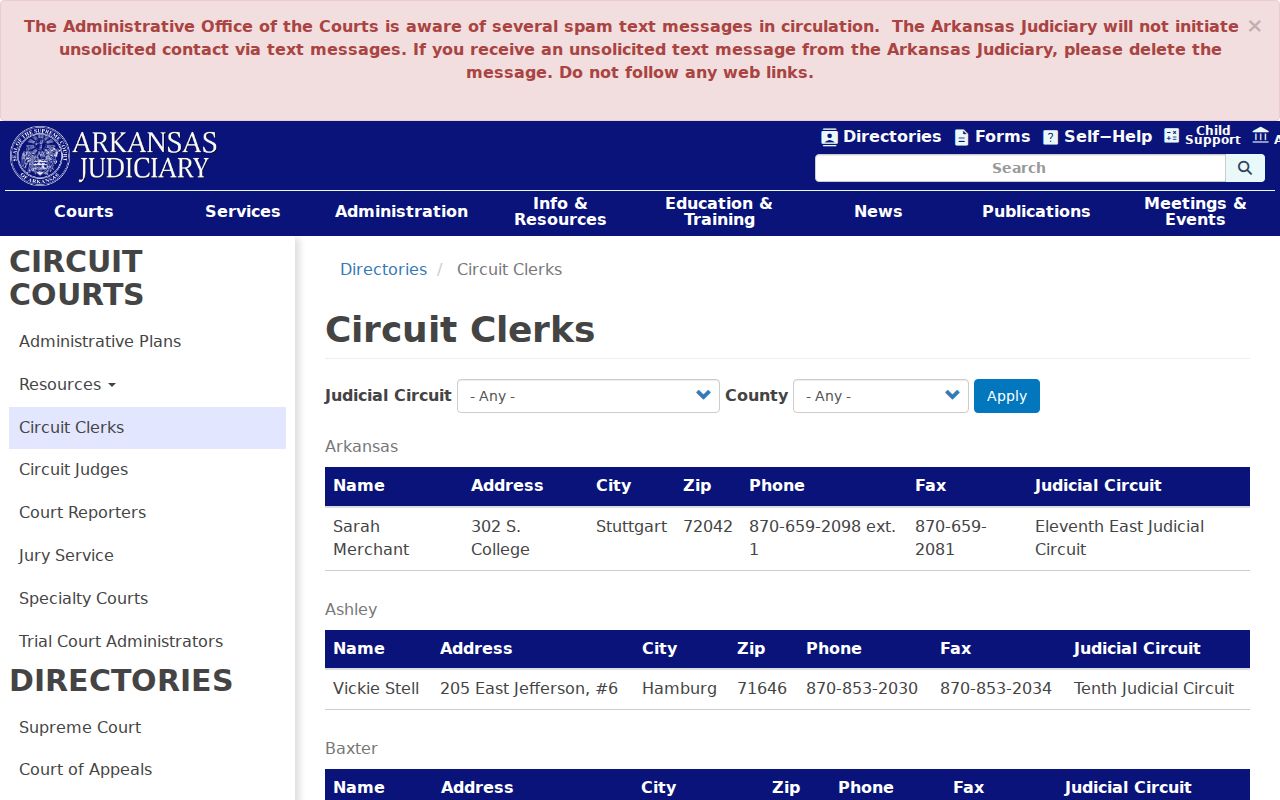
This directory view helps separate the Circuit Clerk from the County Clerk, who keeps county-government and County Court material rather than ordinary felony dockets.
What a Criminal Docket Shows
A Lafayette County criminal docket is a procedural index. It is not a police report, a prosecutor's complete file, or a transcript. Start with the header. Then work down the dated entries. A filing only shows that the clerk accepted a document; it does not prove the judge granted the request. And a case-level status may not state the result of every charge.
| Case Number | The court-assigned search key, shown in the precise format used by the live record. |
|---|---|
| Court and Division | Lafayette County court level, assigned circuit division, and judge when public. |
| Charges | Description, class, and statute when public; each charge may have its own disposition. |
| Filings and Events | Charging paper, counsel appearance, motions, orders, settings, trial, and later review entries. |
| Future Events | Scheduled proceedings that must be checked against later reset or continuance entries. |
| Disposition | Plea, verdict, dismissal, nolle prosequi, sentence, or judgment as recorded for the case or charge. |
Search ARCourts may also list public financial totals and document links. If an image is missing, the underlying order may still have been filed.
Lafayette Charges and Dispositions
One Lafayette County criminal docket can hold several charges, and each can end differently. Read every charge line beside its own disposition. The broad case status is no substitute. A dismissed charge is not the same as one resolved by plea or verdict. "Nolle prosequi" means the prosecutor formally chose not to proceed. That choice applies to that charge at that time. What it legally does depends on the entry and the signed order.
- Information
- A charging document filed by the prosecutor.
- Plea
- The accused person's formal response to a charge.
- Disposition
- The outcome recorded for a case or individual charge.
- Judgment
- The court's formal ruling, including a sentence after conviction or plea.
When you need an exact result, get the signed judgment or sentencing order. The dated event list points you to that filed instrument.
Stages on a Criminal Docket
A Lafayette County criminal docket grows as the case moves. A felony record often opens with an information or indictment. Appearance and arraignment entries then follow. Motions, responses, orders, and setting notices mark the pretrial work. A plea or trial event can lead to disposition and sentencing. Later entries may cover an appeal, mandate, remand, or compliance review.
Docket flow: Filing › Arraignment › Pretrial › Plea or Trial › Disposition › Sentencing
The path is rarely straight. A continuance can move a setting, and a later order can replace an earlier date. The newest valid entry controls the working timeline.
Lafayette Criminal Docket Caseload
The Arkansas Judiciary's county-filtered statistical supplement adds local context. For calendar year 2025, the "By Case" view for Lafayette County criminal matters showed 396 cases pending at the start, 88 filings, 39 dispositions, and 445 pending at year end. Of the new cases, 85 were felonies. The reported clearance rate was 44.3 percent. Dispositions ran behind new filings in that period.
The official statistical supplement entry supplies the Lafayette County criminal docket context captured here.
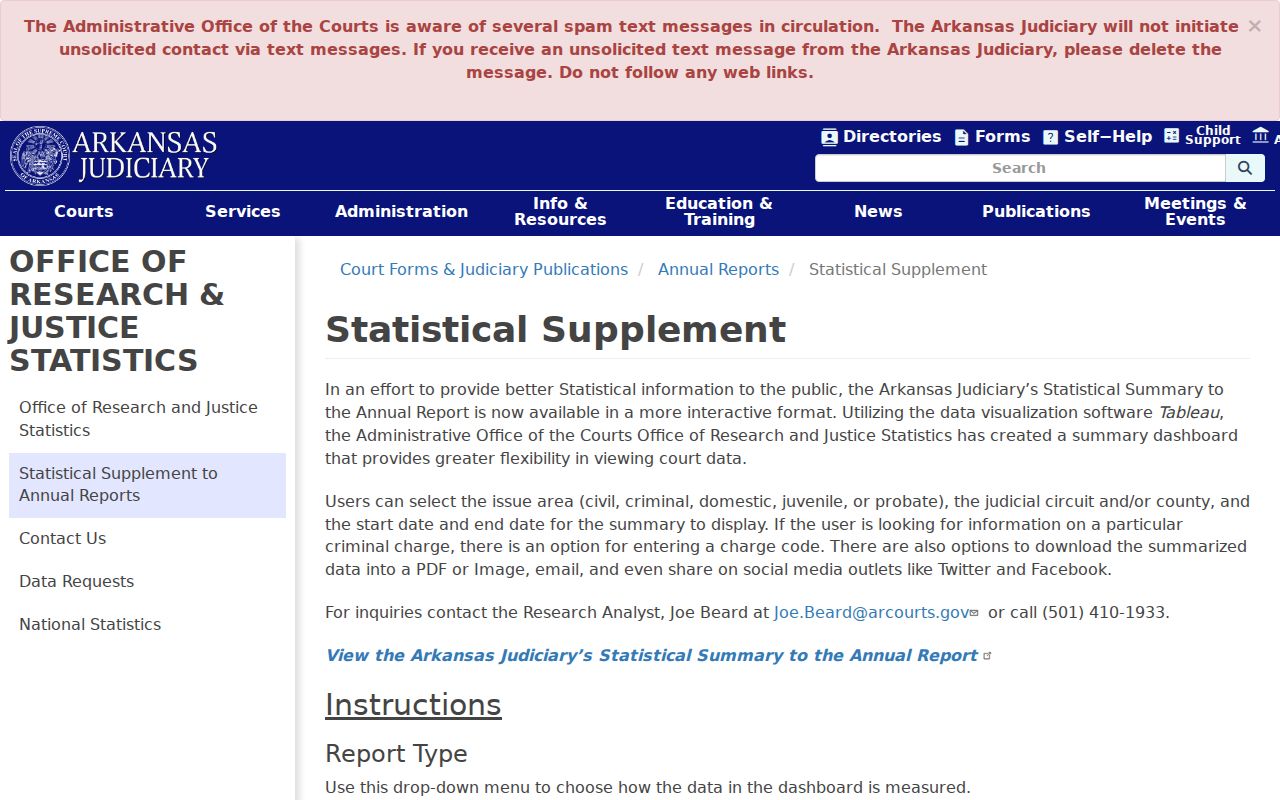
The official route to the dashboard is marked here. County, issue area, report type, and date filters set the numbers. A separate view of the Arkansas annual statistical dashboard shows the interface for that filtered count.
This dashboard backs up the local totals. It cannot replace a live criminal docket or reveal the status of any one case.
Which Court Holds Criminal Dockets
The Lafayette County Circuit Clerk keeps Circuit Court felony files. The office sits at #3 Courthouse Square in Lewisville. Call 870-921-4878. Lafayette County sits in the Eighth South Judicial Circuit with Miller County. Its two circuit judges are Carlton Jones in Division 1 and Brent Haltom in Division 2. Divisions are administrative assignments rather than fixed subject-matter courts. Check the division on the case before asking about a hearing. District Court clerks hold their departments' misdemeanor, traffic, and ordinance records.
Search ARCourts includes some district courts. Statewide materials do not promise full public detail from every district department, though. If a lower-court case does not appear, call the issuing court. Police and prosecutor files have separate custodians, and access limits may differ.
Reset Lafayette Criminal Settings
Treat any date on the Lafayette County criminal docket as a plan, not a promise. The summons, notice, or signed order controls. Before relying on a setting, scan every docket entry filed after it. A continuance the court has granted can push the date aside. So can an amended notice, a transfer, or a reset. One caution deserves emphasis here: a motion to continue is only a request. The appearance still stands unless the judge grants relief.
When a date looks wrong: record the case number, newest event, court, and judge, then ask the responsible clerk or court staff to confirm the current setting.
A fuller docket search sequence for court dates runs through the Lafayette County Court Calendar. Confirm the date directly with the clerk, since a closure, a change of counsel, or a pending continuance request can all move a hearing without much notice.
Public Access and Sealed Criminal Dockets
Arkansas Supreme Court Administrative Order 19 begins with open access to court records. It then carves out anything made confidential. Federal law can do that. So can Arkansas law, court rule, or a court order. Remote access can also be narrower than what you get in person at the clerk's office. Remember that when you search. A public Lafayette County criminal docket shell may stay visible. Even so, one field, entry, or image can be restricted.
Key Rules:
Administrative Order 19 controls public access, remote access, compiled information, and excluded case-record information.
Ark. Code Ann. § 9-27-309 governs confidentiality for juvenile records and related material.
Ark. Code Ann. § 16-90-1401 et seq. supplies Arkansas criminal-record sealing law.
A docket search that returns nothing is not proof no case exists. The record may predate electronic coverage, sit under a different index, belong to another court, or be restricted by law. Ask the clerk which rule applies and what review process is available.
Lafayette Sentencing Order Copies
A Lafayette County criminal docket entry can show that judgment or sentencing happened. The signed order holds the operative terms, though. If Search ARCourts posts a public image, read it as a convenience copy only. It is not clerk certification. For a plain or certified copy, call the Circuit Clerk. Have the case number, document title, and filing date in hand. Before sending a request, ask about the page count and access status. Also ask about the total fee, accepted payment, and delivery choices. The Circuit Clerk publishes fax number 870-921-4879. Printing a fax number does not mean fax orders are accepted. So confirm whether staff take requests in person, by mail, or by fax. The county publishes no copy-fee sheet and promises no turnaround time. For a transcript, go through the judge or clerk. Either can point you to the official court reporter. Neither Search ARCourts nor the clerk's docket office produces transcripts. Note: Keep the case number and the exact filing title ready. Then staff can pull the Lafayette County criminal record without guessing.