
How to Get Court Records
Match the office to the court first. The Lafayette County Circuit Clerk holds Circuit Court files. Those files cover civil cases, felonies, domestic relations, probate, and juvenile matters. A District Court clerk keeps that court's own caseload. That means traffic tickets, misdemeanors, ordinance violations, small claims, and limited civil cases. The elected County Clerk serves county government. It also works for County Court, not ordinary Circuit Court case files. Confusing those two titles is a common way to lose a week.
Public docket and case information runs through Search ARCourts. Use it before requesting copies. Pull the case number, filing title, filing date, court, and status. A public document link there is a convenience copy only. Some needs go beyond the portal. An authenticated record, an old paper file, or a filing with no online image still comes from the Lafayette County Circuit Clerk.
- Identify the court, full case number, document title, and filing date through Search ARCourts or a notice.
- Choose the proper channel: online image, clerk counter, telephone inquiry, or a mail request confirmed with staff.
- Call the custodian first for access status, page count, copy type, fee total, payment method, and delivery time.
- For mail or fax, confirm that the clerk accepts the method and ask for exact payment and return instructions.
- Specify a plain or certified copy and verify the completed record against the court file.
Three Lafayette Court Record Forms
A docket, a filed document, and a certified copy answer three different questions. The docket is a chronological index of the case. It proves an event or filing was entered. Still, a short entry rarely spells out the full terms.
The filed document is the complaint, motion, exhibit, order, or judgment behind that entry. A certified copy adds something more. It carries the clerk's authentication to the reproduction.
| Record | What It Provides | Best Source |
|---|---|---|
| Docket/case information | Case header, parties, filings, events, status, and future events where public | Search ARCourts or the responsible clerk |
| Filed document | The text and terms of a pleading, order, judgment, or public attachment | Public link when offered, then the clerk |
| Certified copy | A clerk-authenticated reproduction for an official purpose | The court clerk holding the original file |
Lafayette Court Record Custodians
Phone calls help you plan, but they are not the record. The Circuit Clerk publishes a fax number. That alone does not mean fax orders are accepted.
Lafayette County promises none of it in official materials. There is no guaranteed public terminal, email request path, local turnaround promise, or counter cutoff. Ask the right custodian about each option before you travel.
Types of Court Records
Lafayette County court records cover more ground than a single docket sheet. Circuit Court files can hold civil, felony criminal, probate, domestic-relations, and juvenile material. Public access differs by record type. District Court handles limited civil claims, small claims, traffic, misdemeanors, and ordinance cases. Appellate and federal records stay with their own courts.
- Docket or case-information printouts and event histories
- Complaints, petitions, answers, motions, and responses
- Notices of setting, signed orders, judgments, and dispositions
- Public exhibits and attachments when access is allowed
- Clerk-certified copies of public Circuit or District Court instruments
Missing Lafayette Court Record Links
A blank document area does not mean nothing was filed. The Arkansas Judiciary portal overview notes this. Depth of events and linked images varies by court. Remote displays may omit some material. That protection comes from Arkansas Supreme Court Administrative Order 19. Search ARCourts opens a window into public data. It does not promise a downloadable scan for every public filing.
If a link is missing: record the case number, filing name, and filing date, then ask the Lafayette County clerk holding that case for the specific instrument.
The Arkansas Judiciary's forms and publications collection shows the state's official court-resource setting.
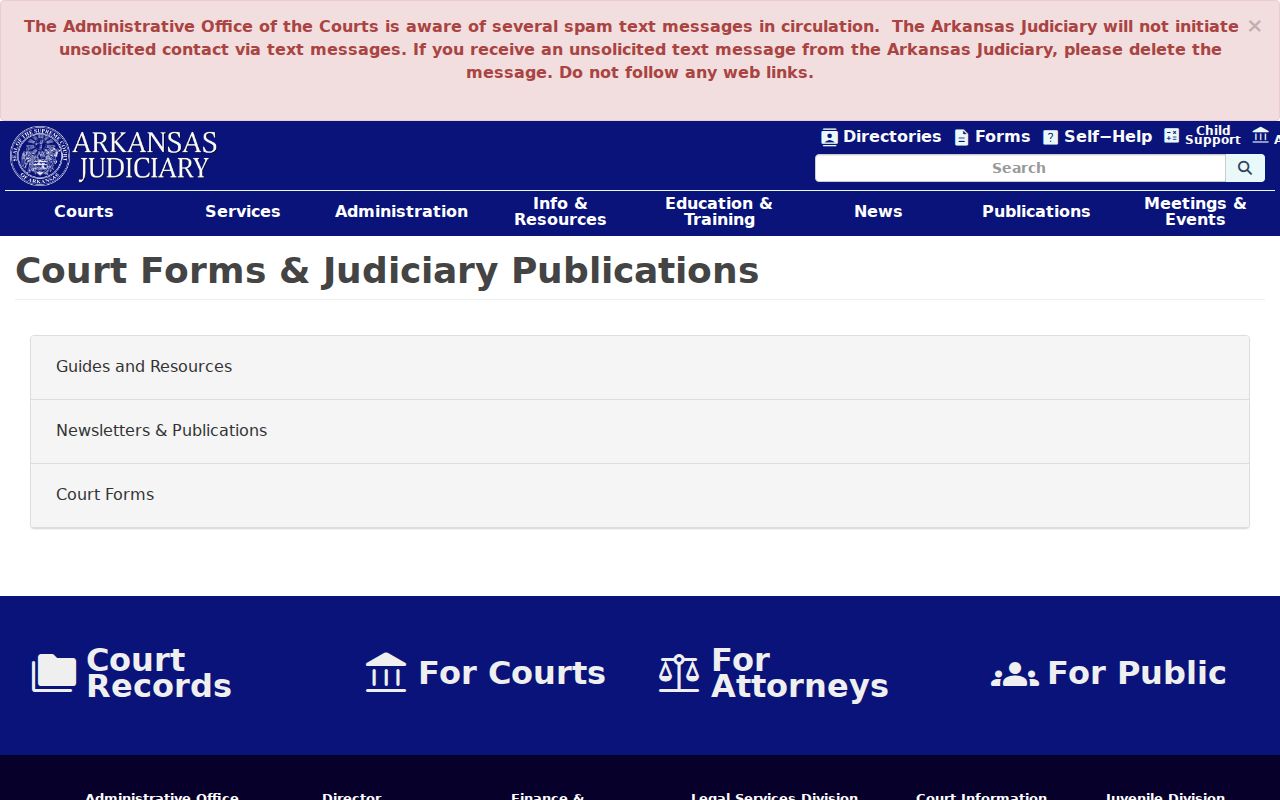
The picture here points to an official forms source, not to a Lafayette County case file. A form can help you frame a filing. The entered case record itself still has to come from Search ARCourts or the clerk.
Lafayette Court Record Transcripts
Transcripts are not docket entries or clerk copies. A court reporter prepares the word-for-word record of a proceeding. So a transcript request goes to the assigned reporter. Do not send it to Search ARCourts.
Ask the judge's office or the clerk. They can name that reporter and explain the estimate process. Transcript rates sit apart from Lafayette County Circuit Clerk copy fees.
What a Court Record Contains
A Lafayette County docket opens with the case header. It then tracks accepted filings and events in time order. Search ARCourts lists what public results can include. That list covers parties, judge, filings, criminal charges and dispositions, future events, judgments, and links to some documents. The full case file may hold far more text than that public event list.
| Case Number | The court-assigned locator used to distinguish the file and request a copy |
|---|---|
| Pleadings | Petitions, complaints, answers, motions, responses, and other accepted papers |
| Orders & Judgments | Signed directions and rulings whose exact terms control |
| Docket Sheet | A dated index of filings, settings, actions, and outcomes |
| Exhibits | Filed evidence or attachments, subject to sealing, redaction, and access limits |
A file mark is the clerk's official receipt date and time. A disposition is the recorded outcome. Neither a motion nor a complaint proves the court accepted its claims. Before drawing any conclusion from a party's filing, look for a signed order or judgment.
Lafayette Court Record Link Limits
A docket entry saying an order was filed is not the order itself. When its exact effect matters, read the signed instrument.
The fuller Lafayette County case search can help you locate the right case before ordering a copy. Only the clerk authenticates a certified copy, though.
Older Lafayette Court Records
Lafayette County Circuit Court adopted the Contexte case-management system on April 11, 2011. That is per the AOC implementation history. The date is a technology milestone, not a public-search cutoff. Some older matters were back-entered. Others may still sit on paper or microfilm. Even a later docket can lack an online document image.
When you chase an older Lafayette County court record, give the Circuit Clerk every solid locator you have. That means court, case number, approximate filing period, record type, and document title. Ask whether archive retrieval adds time or search cost. A zero-result screen is not proof a case never existed. Restricted access, a changed index, the wrong court level, or thin electronic coverage can each explain it.
Note: Ask the clerk about archive retrieval before mailing payment because Lafayette County has no published local turnaround or archive fee schedule.
Certified Copies and Fees
A plain copy just reproduces a public paper. A certified copy adds the clerk's authentication, which courts and agencies often require. The Lafayette County Circuit Clerk posts no official online fee sheet. So do not borrow another county's amounts. Call the office for a current quote. It should separate search, page, certification, postage, and card charges.
| Item | Lafayette County Status |
|---|---|
| View public Search ARCourts data | Free; no basic-search login shown |
| Plain clerk copy | Current amount must be confirmed with the custodian |
| Certified or exemplified copy | Current amount and availability must be confirmed |
| Record search and postage | Ask for a complete quote before submitting payment |
Lafayette County Circuit Clerk
#3 Courthouse Square
Lewisville, AR 71845
870-921-4878
The official directory also renders the location as 3rd & Spruce Streets. Both descriptions point to the same courthouse-square office. Call before visiting to confirm hours, file availability, accepted payment, and whether staff need advance time to pull the record.
Lafayette Court Record Cost Boundaries
Arkansas eFlex serves registered filers who file electronically. It is not a public docket search or a copy-order counter. Its instructions list a one-time account setup fee and a new-case electronic filing surcharge. Neither sum prices a Lafayette County court record. For free public case information, Search ARCourts is the channel. The clerk quotes copy work. The official eFlex payment policy shows this separate filing workflow.
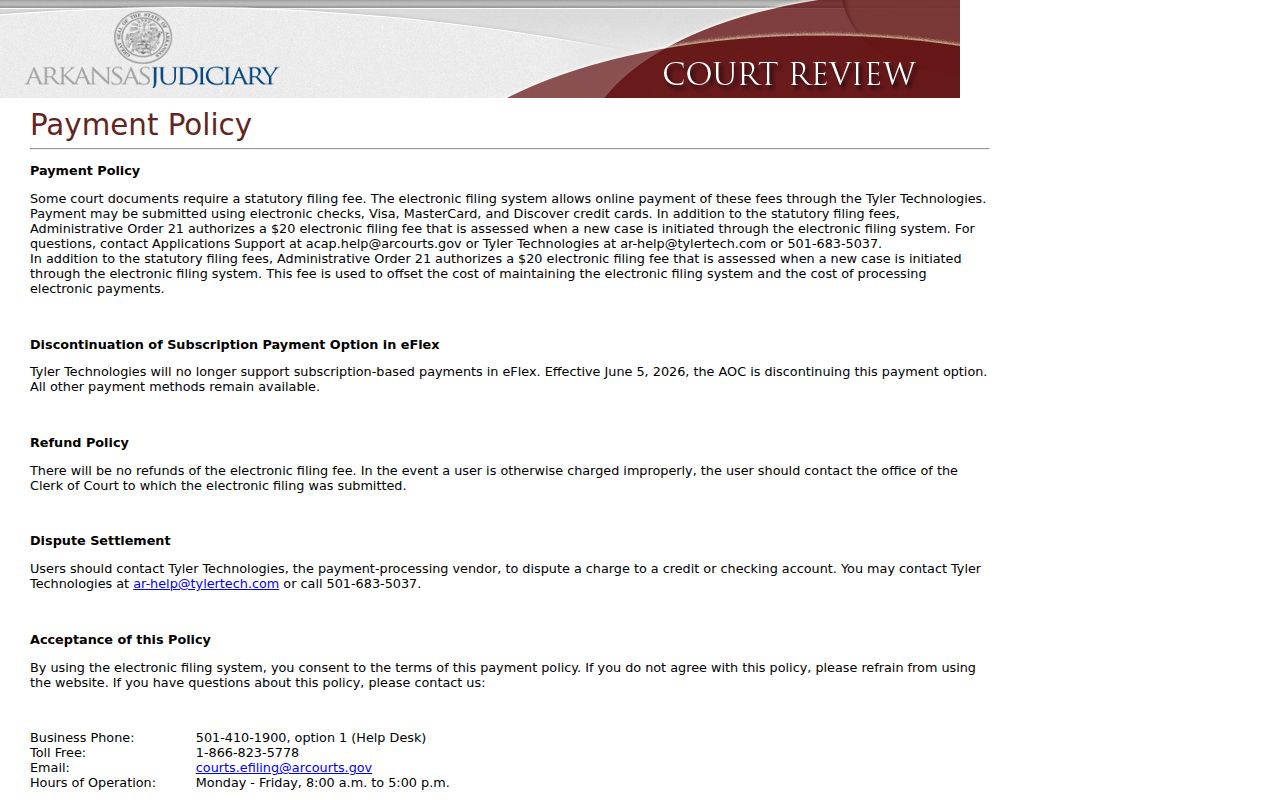
That policy page belongs to the filing side of the system. It is not a Lafayette County Circuit Clerk copy schedule. Nor is it a fee for viewing public docket information.
Lafayette Court Record Request Fields
A precise request lowers the odds of getting the wrong paper or only a docket printout. The Lafayette County clerk publishes no official copy-request form. Still, staff will want the core details before they can act. Share only what is needed to locate and deliver the public court record.
- Court and case number
- The essential locator, including Circuit or the named District Court department.
- Document title and date
- The filed instrument requested, such as a judgment or order, and its docket date.
- Copy type
- Plain, certified, or another form that the clerk confirms is available.
- Delivery and payment
- The approved return method, fee authorization, and payment form given by staff.
For restricted material, describe any legal authority or court order that supports access. Routine identification and payment do not override confidentiality. For mail, ask for the exact payable name, prepayment rule, postage amount, and return-envelope instructions.
Public Access and Sealed Records
Arkansas Supreme Court Administrative Order 19 starts from public access to court records. It then excludes some information. That covers items made confidential by federal law, Arkansas statute, court rule, or court order. Remote electronic access may be narrower. You may see more at the courthouse. A redaction can hide a single field or image, but the public case shell stays intact. Sealing restricts a larger part of the Lafayette County court record.
Key Rules:
Administrative Order 19 governs public access, remote access, compiled information, and excluded case-record information.
Ark. Code Ann. § 9-27-309 addresses juvenile-record confidentiality.
Ark. Code Ann. § 16-90-1401 et seq. governs Arkansas criminal-record sealing.
The Arkansas Freedom of Information Act covers many government records. Filed complaints, judgments, and court dockets are different. They belong with the judicial custodian under court-record rules. If access is denied, ask which rule or statute controls. Also ask what review process applies. And remember: an absent Lafayette County result never proves no case exists.